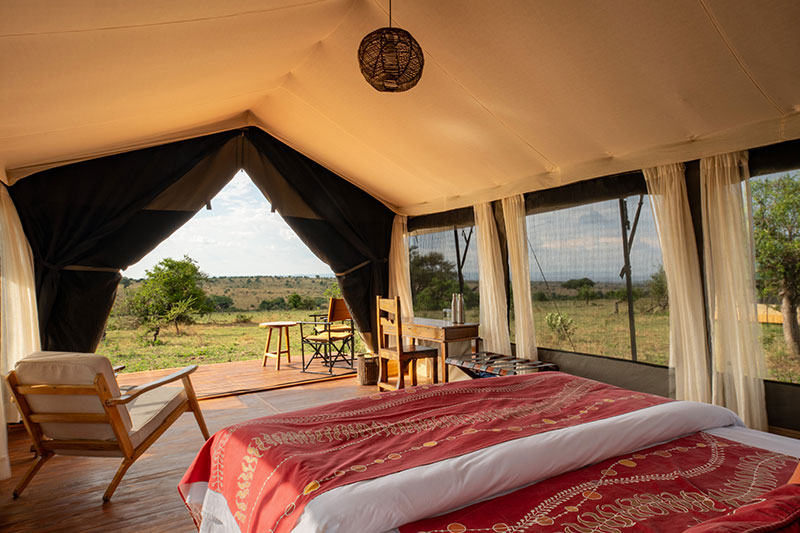
Wayo Serengeti Green Camp
Wayo Serengeti Green Camp Is A Seasonal Mobile Tented Camp Located In The Serengeti National Park Which Moves Twice A Year To Shadow The Main Migration Movements.
Light footprint, adventure camps that immerse guests in the wilderness are at the heart of Wayo Africa’s ethos. Wayo Serengeti Green Camp is very stylish and comfortable, but still follows the Wayo ethos. The camp moves twice a year between the north and south of the Serengeti National Park, to position itself within reach of the migration, but its locations are away from the busiest areas, ensuring guests can still appreciate the wilderness as well as the wildlife. Activities at the camp focus around game drives, however the company also operates an excellent walking safari outfit and a private walking guide can be booked for anyone who wants to do longer walks. Wayo Serengeti Green Camp is ideal for anyone wanting a quality, authentic wilderness experience with great value.


Rooms
Accommodation is provided in 10 guest tents which have been designed with mesh sides to the front and sides, allowing good air flow and making the most of the bush views. Each tent contains either a king sized or twin beds with a dressing area with hanging space behind. There are also two day beds which can be converted to accommodate a triple or quad arrangement. To the rear of each tent is the bathroom which includes a bucket shower (with hot water on demand), a flush loo and double vanity with a jug of water.
Central Areas
The tented mess includes a comfortable lounge and dining area, although dining will take place under the open sky when weather allows. Décor throughout the camp is simple but includes locally sourced craftwork and materials. charging facilities can be found in the mess area only.
Facilities
Wi-Fi – Yes
Power for Charging – Yes
Swimming Pool – No
Habitat and Wildlife
With an area of some 14,000 sq. km, Serengeti is probably the best-known wildlife sanctuary in the world. The ecosystem includes the National Park itself, the Ngorongoro Conservation Area, Maswa Game Reserve and Kenya’s Masai Mara National Reserve, together forming one of the most complex and least disturbed ecosystems on earth. The landscape was originally formed by volcanic activity in the Ngorongoro highlands and it varies from the open short grass plains in the south, to savannah and scattered acacia woodlands in the centre, to extensive woodland and black clay plains in the west, to hilly wooded grassland in the north. Most of the permanent water is found towards the northern and western areas, the lack of permanent water and food in the south being the main reason for the annual migration.
The park is home to approaching 2,000,000 wildebeest, 500,000 Thomson’s gazelle and 250,000 zebra: the largest concentration of plains game in Africa. More than 30 species of herbivores are found here, as well as all the major predators and nearly 500 species of birds.
The southern reaches of the park consist of endless ‘short-grass’ open plains. In the heart of these plains on the border of the Serengeti National Park and the Ngorongoro Conservation Area is an area known as Ndutu, where a series of partial soda lakes and marsh areas are surrounded by woodland. Many of the camps and camp sites in the southern Serengeti are located in this area. To the west the open plains are bordered by the woodlands of the Maswa Game Reserve, and a secondary hub of camps can be found along the edge of woodland, known as the Kusini area. To the east the plains are endless, stretching south-east through the Ngorongoro Conservation Area and north-east towards the Loliondo Game Controlled Area which borders the eastern Serengeti.
The hundreds of thousands of wildebeest, gazelles and zebra congregate on these southern short grass plains from December to April, usually calving around the end of January when the nutritious grass is at its best. During this time the ‘migration’ is restricted to local movements according to rainfall and grazing, though even within the southern Serengeti region the distances are vast. This southern region is exceptional for lion, cheetah and spotted hyaena sightings, all of which thrive on the open plains, whilst leopard, serval, African wild cat, elephant, buffalo, giraffe, eland, topi, jackal, ostrich and impala can also be seen. Wild dogs are making a comeback in the region and are occasionally encountered to the south of Ndutu in the Ngorongoro Conservation Area.
Depending on grazing conditions and water supply, the start of the Serengeti annual migration begins at the end of this period, and the herds begin to march north/westwards, ‘lowing’ incessantly so that the air hums like a dynamo (zebra first, then the wildebeest and gazelles). Lion, cheetah, hyaena and wild dog follow, ensuring that only the fittest survive, while jackals trail behind and vultures circle overhead.
The central and western sections of the park are fantastic for game-viewing all year round, though wild dogs and rhino are not encountered. The central region around Seronera is especially productive for game-viewing but does get very busy with tourists. To the south-east of Seronera is a much more exclusive game-viewing area that stretches towards the border of the park. To the north-west the ‘Western Corridor’ stretches out along the course of the Grumeti River. This region is busiest in June and early July when the wildebeest and zebra herds pass through on their journey north. The habitat of the region changes dramatically from vast open plains in the east to dense riverine woodland along the Grumeti River in the west.
The northern part of Serengeti is a huge area of open plains, rolling hills and acacia woodland, intersected by numerous small streams which flow into the Mara River. The Mara River is a natural focal point, and most camps are located in the Kogatende region to the south of the river. To the north of the river is a section of the park known as Lamai, whilst to the south of Kogatende are the Wogakuria Hills where the rolling hills are interspersed with rocky granite outcrops. The plains stretch east and west to the boundaries of the park, and in the east continue into the Loliondo Game Controlled Area.
The northern Serengeti is exceptional for lion, cheetah and leopard sightings, whilst hyaena, serval, African wild cat, elephant, buffalo, hippo, crocodile, giraffe, eland, topi, jackal, ostrich and impala can also be seen. Wild dogs are making a comeback in the region and are very occasionally encountered, whilst black rhino can sometimes be seen in the north-eastern region around the Sand River.
Although this region offers a wonderful all year round safari experience, it is busiest from July to October when hundreds of thousands of wildebeest, gazelles and zebra congregate on these northern plains. The herds usually arrive in late June or early July, travelling up from the southern and western Serengeti on their annual migration. Many of the herbivores will cross into Kenya’s Masai Mara, but large numbers remain in the northern reaches of the Serengeti, where the Mara River provides permanent water. This movement of so many animals can be dramatic, especially when they cross the Mara River, which can happen at any time between July and early November. ‘River Crossings’ are a favoured highlight for wildlife enthusiasts and photographers, as hundreds of wildebeest stampede into the river whilst crocodiles lie in wait. Around October/November, as the rain clouds gather, the herds head south once more to calve on those nutritious short grass plains before starting the cycle again.
Activities
Activities focus on day-time game drives but as Wayo Africa operates some excellent private mobile walking safaris, they also have guides available at Green Camp for walking opportunities. Shorter walks in the morning or afternoon are included, or for guests looking to enjoy a full day’s walk, this can be arranged at extra cost with a private guide and vehicle.
Seasons
Wayo Serengeti Green Camp is a seasonal mobile tented camp located in the Serengeti National Park which moves twice a year to shadow the main migration movements. Between June and October the camp is located in the Nyamalumbwa area of northern Serengeti, around 90 minutes from the Mara River; and from December to March the camp is found in the Kusini area of southern Serengeti National Park. The camp is closed in April, May and November. Wildlife viewing is excellent during all months of operation.
Wayo Serengeti Green Camp accepts children of all ages, and those below 16 years must share a room with their parents – days beds can be converted into extra beds for children. The minimum age for walking safaris is 12 years. Due to the remote and wild nature of the camp, we feel the camp is better suited to those travelling with older children who would enjoy the adventurous nature of the camp and be able to join both game drives and guided walks.
Wayo Africa has a sustainable approach to all its operations, including its light footprint ‘green camps’ which use solar powered lighting and have their own water filtration plant to avoid the use of plastic bottles. They have a strong local procurement policy, including Tanzania-made camps and furnishings.
The company has helped establish Children in the Wilderness programmes in Tanzania (a non-profit organisation working to support communities and children in conservation through education), directly working with and supporting over 100 vulnerable children, as well as partnering with a local women’s empowerment project.