Fundu Lagoon
Fundu Lagoon Is A Barefoot Luxury Beach Lodge Situated On Pemba Island’s Beautiful Wambaa Peninsula.
Fundu Lagoon is set on a sandy beach in 18 acres of secluded forest on the western coast of the unspoiled island of Pemba. The lodge can only be reached by boat from the island’s airport, adding to the feeling of being castaway. Accommodation is quintessentially ‘barefoot luxury’ with tented rooms and suites under thatch with an understated design and the lodge has a very laid back vibe. If you’re looking for complete seclusion, the Superior Suites are almost mini villas with separate living/relaxing areas and private plunge pools with direct beach access, whilst the standard rooms are more modest. The real draw of Fundu however isn’t the accommodation, it’s the pristine setting and rare feeling of being away from it all. Pemba also offers world class diving and Fundu’s own dive centre is excellent offering both diving and snorkelling (day trips to the stunning Misali Island are a highlight). Fundu Lagoon is popular with honeymooners, understandably, but it’s ideal for anyone looking for a secluded and relaxed beach retreat with the added attraction of some of the best diving in Africa.


Rooms
The lodge caters for up to 40 guests in a range of luxury tented rooms and suites built onto wooden decks. Each room is comfortably furnished and has en suite plumbed facilities, electricity, cooling fans, a mini fridge stocked with drinks, a safe, and a private verandah. Four of the standard rooms are situated within thick forest on the edge of the beach (beachside rooms) while the other eight standard ‘hillside’ rooms are located behind, further up the ridge offering fantastic views out over the bay (access does require quite a climb up some steps). There are two ‘standard’ suites – the beach suite with direct access to the beach, and the jungle suite (located on the hill offering greater privacy but no direct access to the beach). Both standard suites also have a small private plunge pool. The very spacious four superior suites are located at the end of the beach and each has a tented bedroom and enjoys a vast deck with private plunge pool and double storey open air lounge with direct access to the beach.
Central Areas
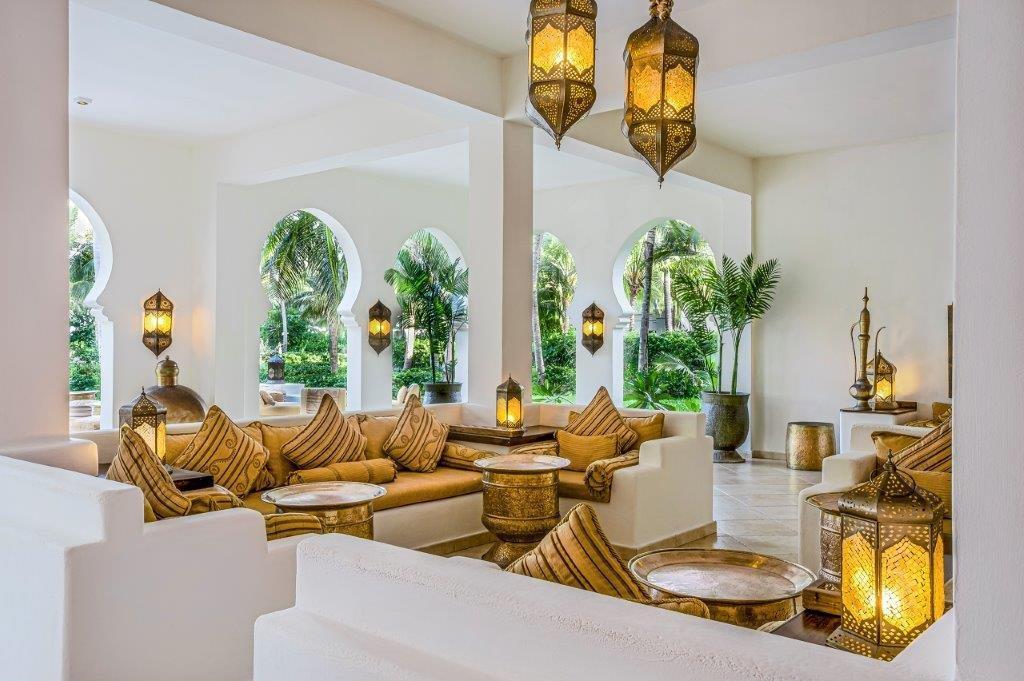
The central thatched area houses the main bar and restaurant, while an impressive jetty leads out to a second bar and dining space, where guests often gather to watch the amazing sunset over the water. There is a cosy television and games ‘snug’, a yoga platform, a spa offering a range of massages, and a stunning infinity swimming pool set up the hill, with its own bar (note, there are a considerable number of steps to reach the pool). There is also a beach bar.
Facilities
Wi-Fi – Yes
Power for Charging – Yes
Swimming Pool – Yes
Habitat and Wildlife
Zanzibar’s, or more correctly Unguja’s (Zanzibar is the name of the archipelago which includes both Pemba and Unguja islands), history dates back more than 2000 years when the islands traded with ships from Persia, Arabia and India. From about the 10th century, groups of immigrants from Shiraz (Persia) settled on the island and mixed with the local people. In the 16th century, the Portuguese established a trading station before being ousted by Omani Arabs a couple of centuries later. In 1840, the Sultan Said moved his capital from Muscat to Zanzibar with the Omani Arabs forming an elite group of landlords and rulers. Indian settlers formed a merchant class and the island became an important centre of regional politics and the focus of the slave trade.
In 1890, Zanzibar became a British protectorate before gaining independence in 1963. In 1964, the Sultan was overthrown and nearly all Arabs and Indians expelled. Later that year, Zanzibar and Tanganyika combined to form Tanzania. Since then, many of the expelled peoples have returned.
Like most of East Africa, the islands are affected by the monsoon winds – the Kuzi (or sometimes Kisi) which blows from April to September/October is a south-easterly which brings choppy sea conditions and seaweed to the shorelines, whereas the Kaskasi blows from the north-east from October/November to March producing calmer seas and slightly higher temperatures.
With its rolling green hills and extensive clove plantations, Pemba remains far less developed than Zanzibar’s main island of Unguja, giving it a peaceful, untouched atmosphere. Its small villages and strong Swahili cultural traditions make it an appealing destination for travellers seeking authenticity and natural beauty.
Diving around Pemba Island is considered some of the best in the Indian Ocean, thanks to its untouched reefs and rich marine biodiversity. The island is surrounded by steep drop-offs, vibrant coral gardens, and strong currents that attract large marine life including barracuda, giant trevallies, Napoleon wrasse, giant groupers, turtles, barracuda and thousands of reef fish. Compared to other diving spots in Zanzibar, Pemba offers a more remote and less crowded experience. Combined with excellent visibility and dramatic coral formations, these features make diving in Pemba especially exciting and rewarding.
Activities
There are a wide range of activities available at Fundu Lagoon, most based around the water. Included in your stay are: unguided mangrove canoe safaris to explore the forested shores close to the lodge; unguided kayaking on the house reefs surrounding the resort; the use of snorkelling equipment (there is limited snorkelling from the beach and jetty); and guided village visits – within walking distance of the lodge are three traditional villages and the lodge staff are very happy to welcome guests to their local village where you’ll be welcomed and learn about the local culture (guests are requested to dress modestly, ask permission before taking photographs, and refrain from handing out gifts).
The rest of the activities are at extra cost and the lodge has its own 5* PADI Dive centre which organises diving, snorkelling trips (including a full or half day trip to Misali Island which is not to be missed – full days include a picnic on a stunning beach), night snorkelling, dolphin trips, and fishing. Inland it is possible to arrange an island tour taking in a spice farm, Ngezi Forest or a city tour.
Seasons
Fundu Lagoon is open between July and mid April. July to October are pleasantly warm and dry months to travel. Between November and March temperatures and humidity increase and rain can be experienced. From mid March to April, conditions become wetter as the long rainy season starts to arrive. The calmest sea conditions are found from September onwards, with stronger currents from June to August.
Children over the age of 12 years are accepted at Fundu Lagoon, however the lodge is really geared towards adults with no family specific facilities.
Fundu Lagoon has developed a sustainable style of eco-tourism that works closely with local communities to promote the conservation and environmental management of Pemba Island. They work closely with neighbouring villages, helping to improve facilities for education and health care, including water supply. Fundu also supplies the local communities with boat transport when medical emergencies arise.